Does a Silk Pillowcase Get Hot? What Hot Sleepers Should Use
This guide contains affiliate links. We may earn a commission if you buy through them, at no extra cost to you. How that works.
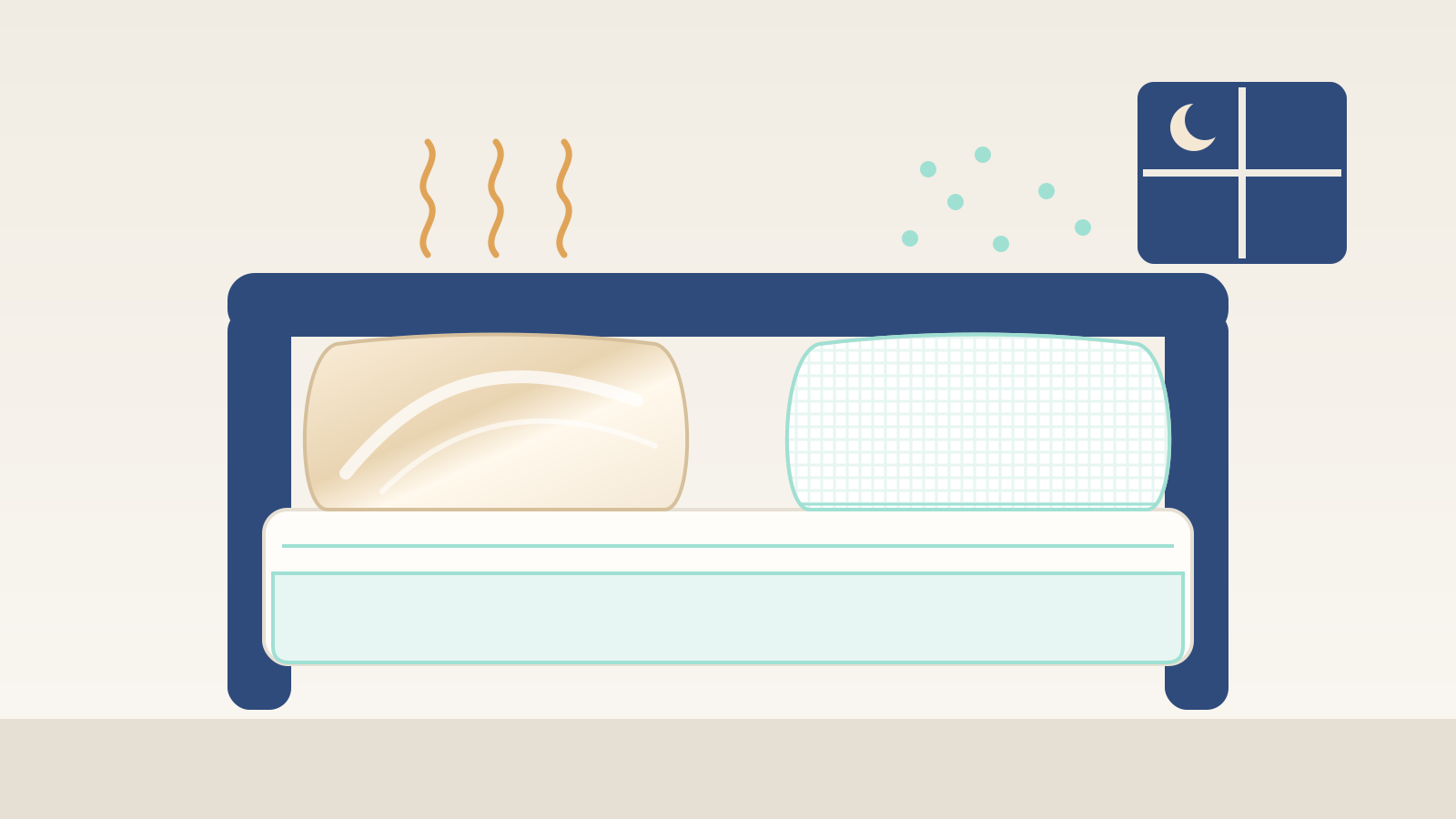
In short
Real silk takes up moisture vapor well, but a silk pillowcase can still feel warm. Its cool first touch only lasts a moment, a glossy silk case is a satin weave rather than a crisp, open one, and silk doesn't wick liquid sweat well. 'Satin' cases are also often polyester, which barely absorbs moisture at all. If you wake up damp, a cotton percale or linen pillowcase is the safer bet.
The short answer
If your silk pillowcase gets hot, there are four likely reasons: the case isn’t really silk, its glossy satin weave, sweat that silk doesn’t wick away, or the pillow underneath. Real silk takes up moisture vapor well, but its cool first touch is only the first moment. If you wake up damp, a cotton percale or linen case is the safer switch.
Below: why silk can feel warm, what the textile research actually says (less than the brands claim, on both sides), a quick check you can run tonight, and which pillowcase suits which sleeper.
Why a silk pillowcase can feel hot
It may not be silk. “Satin” is a weave, not a fiber. The Sleep Foundation explains that satin “was originally made exclusively from silk,” but today “is often woven from synthetic fibers like nylon, polyester, and acetate” (Sleep Foundation). That matters because polyester is hydrophobic: reference tables put its moisture regain (how much water vapor a dry fiber takes up from the air) at 0.4%, against 11% for silk (Sherry et al., 2023). A polyester case can look and feel like silk while taking up almost none of the moisture your skin gives off.
The weave. A glossy silk case is a satin weave: threads float over four or more crossing threads before going under one, and that is what “gives satin its characteristic sheen” (Sleep Foundation). The Sleep Foundation says cotton sateen, the same weave family, is “more prone to heat retention than some alternatives,” while percale, the plain one-over-one-under weave, is “often considered the best type of sheet for people who tend to sleep hot” (Sleep Foundation). That was written about cotton sheets; nobody we found has tested silk pillowcases the same way.
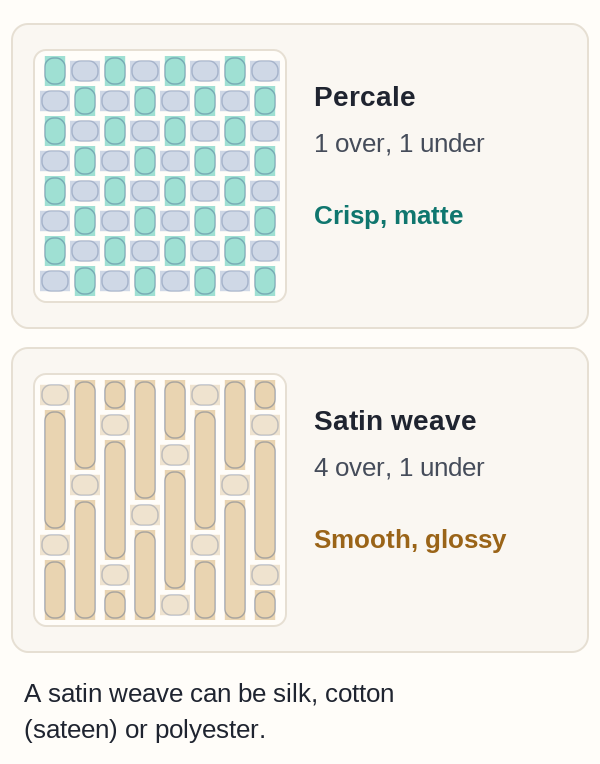
“Cool to the touch” only lasts a moment. The cool feeling when you first lie down is “the very first sensation,” and it depends on how much of the fabric is in contact with your skin (Pac et al., 2001). The lab measure behind “cool touch” claims, Qmax, describes “a cooler initial feeling when touching the fabric” (Vasile et al., 2024). It says nothing about 3 a.m. Silk also insulates: the Sleep Foundation notes it “functions as a good insulator that weighs less than cotton, flannel, or wool” (Sleep Foundation).
Momme. Silk is graded by momme, “a weight-based measurement,” and the Sleep Foundation calls 19 to 25 the ideal range (Sleep Foundation). Fabric thickness is one of the factors that shape how warm a fabric is (Li et al., 2024), so a lighter momme may feel lighter. But we found no test of momme and pillowcase heat, so treat “buy 19 momme if you run hot” as a guess, not a finding.
The pillow underneath. A pillowcase is one thin layer. If it covers a solid memory foam block, the heat may be coming from inside. See what to do when a memory foam pillow is too hot.
What the textile research says
Here is what we could actually find, for the fibers rather than for finished pillowcases.
- Silk takes up water vapor well. Reference values for moisture regain: silk 11%, linen 9 to 12%, polyester 0.4% (Sherry et al., 2023); cotton around 8% (Sayam, 2026); lyocell 10 to 13%, against 7 to 8% for cotton (Varnaitė-Žuravliova & Baltušnikaitė-Guzaitienė, 2024). These are fiber values from reference tables, not measurements of pillowcases.
- But silk is weak at wicking liquid sweat. A 2026 review sums it up: “Silk, though less effective in liquid wicking, allows efficient moisture vapor transmission” (Sayam, 2026). In one lab wicking test of five knitted fabrics, silk “absorbed the smallest volume of liquid with no visible wicking capacity” (Sherry et al., 2023). Those were knits, not woven pillowcases, but it may explain why some hot sleepers find silk fine when they’re warm and clammy once they actually sweat.
- No sleep study has tested silk. A 2024 systematic review found nine studies comparing bedding or sleepwear fibers. The fibers tested were cotton, polyester, wool, down, linen and blends; silk wasn’t among them, and the authors concluded “it is hard to draw an overall conclusion” (Li et al., 2024).
- One small study favors linen. In a nap study of eight young men in a warm, humid room (about 84°F, 70% humidity), a set of linen sheets, bed pad and pillowcases led to fewer awakenings than cotton sheets and pillowcases with a polyester bed pad. The review notes the bed pads also differed, so “it is difficult to establish” which piece made the difference (Li et al., 2024).
That may be why brands disagree: some say silk keeps moisture off your face, others say it traps warmth. The fiber data says silk handles vapor well and liquid poorly. Nobody has measured it on a pillow.
Is it the pillowcase? A quick check
- Read the label. “Satin,” “silky” or “polyester” means it isn’t silk. Look for “100% silk”.
- Ask: warm, or damp? Warm but dry points to the weave or the pillow. Damp and clammy points to sweat the case isn’t moving.
- Feel the pillow under the case. If the pillow itself is warm when you wake, the fill is part of the problem.
- Run a swap test. Sleep two or three nights on a plain cotton percale case, same pillow, same room. If you sleep cooler, it was the case.
- Check where you’re hot. Just your face and neck points to the pillowcase. Your whole body points to the room, mattress or covers.
Silk vs cotton vs linen vs lyocell
| Real silk | Cotton percale | Linen | Lyocell (TENCEL) | |
|---|---|---|---|---|
| Fiber moisture regain (reference values) | 11% | About 8% (cotton fiber) | 9–12% | 10–13% |
| Liquid wicking | Weak, per one review and one lab test | “Effective,” per one review | Wicked in one lab test (knitted sample) | “Excellent,” per one review |
| Weave | Glossy cases are a satin weave | One over, one under | Not stated on our pick’s page | Our pick: sateen |
| Sleep research | None found | Lost to linen in one nap study (with a polyester pad) | One small nap study: fewer awakenings | None found |
| Care (our pick) | Quince: hand wash, or cold gentle cycle in a bag; line dry | Parachute: machine washable | MagicLinen: warm gentle wash; air dry or tumble low | Buffy: machine wash cold, tumble dry low |
Which pillowcase for which sleeper
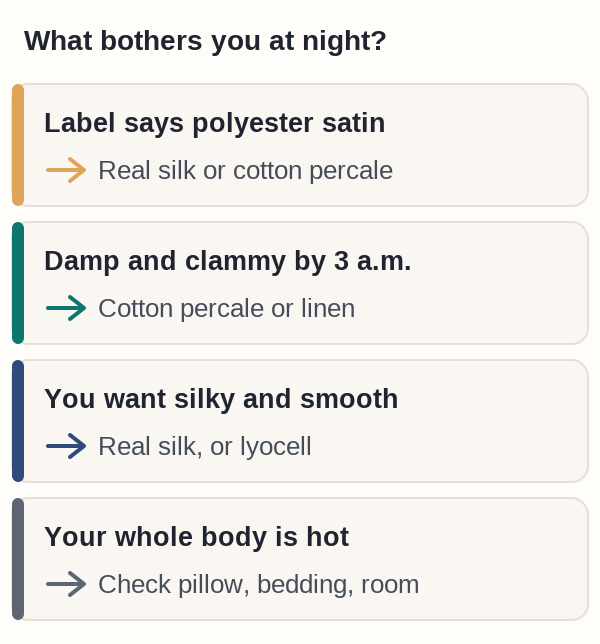
- You love silk and only feel a bit warm: keep silk, but make sure it’s real silk, and take a thick protector or a solid foam pillow out of the equation first.
- You wake up damp or clammy: switch to cotton percale or linen. Percale is the easy, washable choice; linen has the one sleep study.
- You want silky without the care: lyocell feels smooth and washes in a normal machine, but its sateen weave makes it a middle option, not the coolest.
- Your case says polyester satin: that’s the first thing to replace.
Caring for the case you pick
- Silk: follow the label. Quince recommends hand washing in cold water, allows a cold, gentle machine cycle in a garment bag, and says not to tumble dry.
- Cotton percale: machine washable, per Parachute.
- Linen: MagicLinen suggests a warm, gentle wash up to 104°F, no bleach or fabric softener, and air drying or a low tumble.
- Lyocell: Buffy says machine wash cold and tumble dry low.
- Whatever the fabric: a case only works if it’s what touches you. A waterproof protector or a second case underneath adds a layer between your face and the fabric you chose.
Does a silk pillowcase make you sweat?
We found no evidence that silk makes you sweat more, but it won’t help much once you do. Silk takes up water vapor well, yet a review and one lab test found it weak at wicking liquid. If you wake up with a damp face, a cotton percale or linen case is the better bet.
Is silk or satin better for hot sleepers?
Real silk, if the satin is polyester. Satin is just the weave; polyester satin takes up almost no moisture (0.4% regain against silk’s 11%, in reference values). The Sleep Foundation’s view: silk “is typically more breathable than satin made with synthetic materials.”
What is the coolest pillowcase material?
No study has ranked pillowcases by temperature. Among the fibers here, linen has the only (small) sleep study in its favor, and cotton percale is the weave the Sleep Foundation recommends most for hot sleepers. Claims that any one fabric is a set number of degrees cooler come from brands, not independent research.
Is a silk or cotton pillowcase better for hot sleepers?
It depends on what “hot” means for you. If you just feel warm and like silk, real silk is fine. If you sweat, cotton percale is the safer, cheaper and easier-to-wash choice.
When it isn’t the pillowcase
If changing the case doesn’t help, look at the bigger layers: a memory foam topper that sleeps hot, whether cooling pillows work, bedding for night sweats, or, if you share the bed with someone who runs cold, the two-duvet fix. If your neck is the problem rather than the heat, check whether your pillow is too high or too low.
If you wake up soaked rather than warm, bedding is unlikely to be the whole answer. Cleveland Clinic advises: “Schedule a visit with a healthcare provider if you have night sweats that disrupt your sleep” (Cleveland Clinic).
How we researched this
This is a research comparison, not a hands-on test. We haven’t slept on these pillowcases ourselves. On November 18, 2026, we read the top Google results for this question, the studies and reviews linked above (one, Pac et al., only as an abstract), and the Sleep Foundation’s guides, and we checked each pillowcase’s materials, sizes, care and return terms on the maker’s own website. Claims such as “cool to the touch” are the makers’, and we say so. We list no prices because they change; check the seller’s page.
Our picks
Quince 100% Mulberry Silk Pillowcase
mulberry silk pillowcase
- Best for
- People who love silk and want to keep it, but want real silk rather than polyester satin
- Why it won
- 100% mulberry silk at a stated 22 momme, OEKO-TEX Standard 100 certified, with a zipper closure, in standard, queen and king sizes. The maker says it can be machine washed cold on a gentle cycle in a garment bag (hand washing is its preferred method). A 365-day return window gives you time to judge it through a warm spell.
- Watch out
- Sold individually, and line-dry only (no tumble dryer). Its 22 momme sits in the middle of the 19–25 range the Sleep Foundation calls ideal; nobody we found has tested whether a lighter momme sleeps cooler. If you wake up damp, cotton or linen is the safer bet.
- What it beat
- Picked over pricier silk cases because it states the two things that matter for this problem, real mulberry silk and its momme, and its long return window lets you run the swap test below before you commit.
Parachute Percale Pillowcase Set
cotton percale pillowcases
- Best for
- Hot sleepers who wake up damp or clammy, and anyone who wants the simplest, fully washable fix
- Why it won
- 100% long-staple Egyptian cotton in a percale weave, made in Portugal and OEKO-TEX Standard 100 certified. Sold as a set of two in standard and king, with a choice of back envelope, side envelope or side open closure. Machine washable. The maker recommends it 'if you get hot at night'.
- Watch out
- The page doesn't state a thread count. Percale feels crisp rather than silky, and the Sleep Foundation notes it tends to wrinkle and can be a little noisy. Returns within 60 days, per the maker.
- What it beat
- Brooklinen's Classic Percale, our pick in the memory foam pillow article, is just as sound a choice. We picked Parachute here to show a second good option, with more closure styles; either does the job.
MagicLinen Linen Pillowcase
linen pillowcase
- Best for
- Very hot sleepers who want the one bedding fabric with a sleep study behind it, small as it is
- Why it won
- 100% European flax linen, a 190 gsm midweight fabric, pre-washed, with an envelope closure. OEKO-TEX Standard 100 certified and handcrafted in Lithuania, in standard, jumbo, queen and king. The maker says to wash it warm on a gentle cycle (up to 104°F) and air dry or tumble dry low.
- Watch out
- Sold individually, not as a pair. Returns are accepted within 30 days only for unused, unwashed items, so you can't sleep on it and send it back. It ships from Lithuania.
- What it beat
- Beat the silk case for people who wake up damp: linen fibers take up a similar share of moisture to silk, and linen is the only fabric here with even one sleep study (a set of sheets and pillowcases, not a case alone).
Buffy Breeze Pillowcases
TENCEL lyocell pillowcases
- Best for
- People who want a smooth, silky feel with easier care than silk
- Why it won
- 100% TENCEL lyocell in a sateen weave, sold as a set of two in standard (20 x 29 in) and king (20 x 36 in). Machine wash cold, tumble dry low. OEKO-TEX Standard 100 Class I. The maker cites an Intertek cool-to-the-touch (Qmax) test and a fiber test in which lyocell took up more moisture than cotton. A 7-night at-home trial and 50-night returns, per the maker.
- Watch out
- It's a sateen weave, which the Sleep Foundation says may be more likely to trap heat than percale (writing about cotton sheets). The cool-touch figure the maker reports measures the first moment of contact, not the whole night, and isn't a head-to-head with other pillowcases.
- What it beat
- Beat cotton sateen for people who want silky, because lyocell fibers take up more moisture than cotton in published reference values; lost to percale and linen for the hottest sleepers because of the sateen weave.
Watch
- Is your silk pillowcase even silk? Check the label (YouTube Short, 0:30)
Sources
- How do sleepwear and bedding fibre types affect sleep quality: A systematic review (Li, Halaki & Chow, 2024), Journal of Sleep Research, via PubMed Central
- Biohybrids: Textile fibres provide scaffolds and highways for microbial translocation (Sherry et al., 2023), Frontiers in Bioengineering and Biotechnology
- Natural fibers in sustainable materials: extraction technologies, fiber modification, and performance–sustainability relationships (Sayam, 2026), RSC Advances
- Properties, Production, and Recycling of Regenerated Cellulose Fibers: Special Medical Applications (Varnaitė-Žuravliova & Baltušnikaitė-Guzaitienė, 2024), Journal of Functional Biomaterials
- Warm-Cool Feeling Relative to Tribological Properties of Fabrics (Pac et al., 2001), Textile Research Journal
- Effect of Weave and Weft Type on Mechanical and Comfort Properties of Hemp–Linen Fabrics (Vasile et al., 2024), Materials (MDPI)
- Satin vs. Silk Pillowcase (updated Sep 8, 2023), Sleep Foundation
- Sateen vs Percale Sheets (updated Sep 19, 2026), Sleep Foundation
- Best Silk Pillowcases (updated May 7, 2026), Sleep Foundation
- Night Sweats, Cleveland Clinic