Memory Foam Pillow Too Hot? What to Switch To (and What to Try First)
This guide contains affiliate links. We may earn a commission if you buy through them, at no extra cost to you. How that works.
In short
A memory foam pillow usually sleeps hot because a solid block of foam molds closely around your head and moves little air. The most direct fix is a fill that lets air through: shredded latex, buckwheat hulls, or shredded foam you can thin out. A crisp cotton pillowcase is the cheapest thing to try first.
The short answer
If your memory foam pillow is too hot, the usual reason is a solid block of foam molding closely around your head and neck, with little air moving through it. The most direct fix is a fill that lets air through: shredded latex, buckwheat hulls, or shredded foam you can thin out. A crisp cotton pillowcase is the cheapest thing to try first.
Below: why it happens, a quick check to make sure the pillow is really the problem, a rule for what to switch to, and the questions people ask most.
Why memory foam pillows sleep hot
Memory foam was designed to flow “to match the contour of the body pressing against it” and spring back when the pressure is gone (NASA Spinoff). That close, cradling fit is exactly why people like it. It’s likely also why it can run warm: there’s very little space between your head and the foam for warm air to escape.
The Sleep Foundation’s product testers put it plainly. Memory foam pillows “may retain heat and restrict airflow,” solid memory foam pillows “struggle during temperature control tests,” and “a solid piece of foam will generally retain more heat than shredded foam” (Sleep Foundation).
One honest note: we couldn’t find peer-reviewed studies that compare pillow fills head to head for heat. What we know comes from how the materials are built and from editorial lab tests like the one above. So treat any claim that one fill is “X degrees cooler” with suspicion, ours included. We don’t make one.
Why a hot pillow matters at all
The bedroom’s warmth is one of the most important things that affect sleep, according to a review of the research. It found that in real-life conditions, with bedding and pajamas, heat exposure increases time awake and cuts into deep and REM sleep, and humid heat adds to the load (Okamoto-Mizuno & Mizuno, 2012).
A cooler head can help a little, but it isn’t the whole story:
- In a small study of nine young men sleeping in a hot, humid room, a cooling pillow meant time awake was no longer significantly different from sleep in a comfortable room, and whole-body sweating was lower (Okamoto-Mizuno et al., 2003).
- In another study of 16 men in a room at about 90°F (32°C), cooling the head and neck alone only slightly improved comfort and how well they felt they slept. Cooling the back and head together worked best (Lan et al., 2018).
The takeaway: a cooler pillow is a sensible fix for a hot head. If your whole body is hot, the pillow is only one piece, and the room, mattress and covers matter more (if it’s a foam topper on the mattress, see what to do when a memory foam topper is too hot). If you run hot and your partner runs cold, see the two-duvet fix for hot and cold sleepers. NHLBI’s advice is a bedroom that’s “quiet, cool, and dark” (NHLBI).
Is it the pillow? A 3-minute check tonight
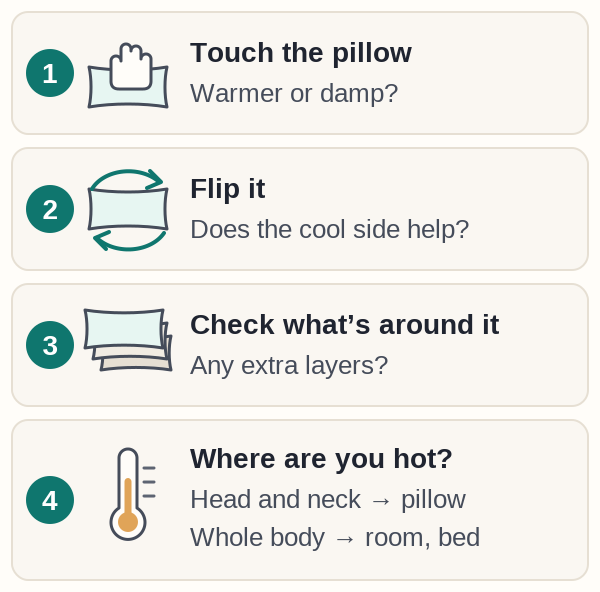
- When you wake up warm, touch the pillow. Put your palm where your head was, then on a part of the sheet nobody’s touched. Is the pillow clearly warmer, or damp?
- Flip it. If the cool side feels good and you drift back off, the pillow’s surface is part of the problem.
- Check what’s wrapped around it. A waterproof protector, a jersey or fleece case, or a second pillow stacked underneath all add layers between you and the air.
- Ask where you’re hot. Just your head and neck points to the pillow. Your whole body points to the room, the mattress or the duvet.
If steps 1 and 2 say “pillow” and step 3 found nothing extra, it’s time to change the fill.
The decision rule: what to switch to
- If you love the sink-in feel of memory foam, switch to shredded memory foam you can adjust. You keep the feel, gain air gaps, and can pull out fill to make it thinner.
- If you run hot and want something springier, switch to shredded latex.
- If you run very hot, like firm support and don’t mind some weight and sound, switch to buckwheat.
- If you’re not ready to replace the pillow, start with a cotton percale pillowcase, take off any extra protector or second pillow, and see if that’s enough.
- Whatever you pick, match the height to how you sleep. Makers generally size their taller pillows for side sleepers. Saatva, for example, sizes its latex pillow at about 4–5 inches for back and stomach sleepers and 6–7 inches for side sleepers.
Memory foam vs shredded foam vs latex vs buckwheat
| Solid memory foam | Shredded memory foam | Shredded latex | Buckwheat | |
|---|---|---|---|---|
| Feel | Slow, cradling sink | Softer, squishier sink | Springy, bounces back | Firm, holds its shape |
| Heat (Sleep Foundation’s testing notes) | Tends to retain heat | Holds less heat than solid foam | More breathable than synthetic foam | Air pockets prevent heat build-up |
| Adjust the height | No | Yes, remove fill | Some models (Saatva: removable fiber layer) | Yes, add or remove hulls |
| Weight and sound | Quiet | Quiet | Quiet | Heavy (Hullo’s standard size: 9 lb 12 oz); hulls rustle |
| Washing | Varies by model; check the label | Varies by model (the Coop is machine washable) | Saatva: wash the cover and fiber layer, never the latex core | Hullo: empty the hulls, then wash the cover |
What to look for when you replace it
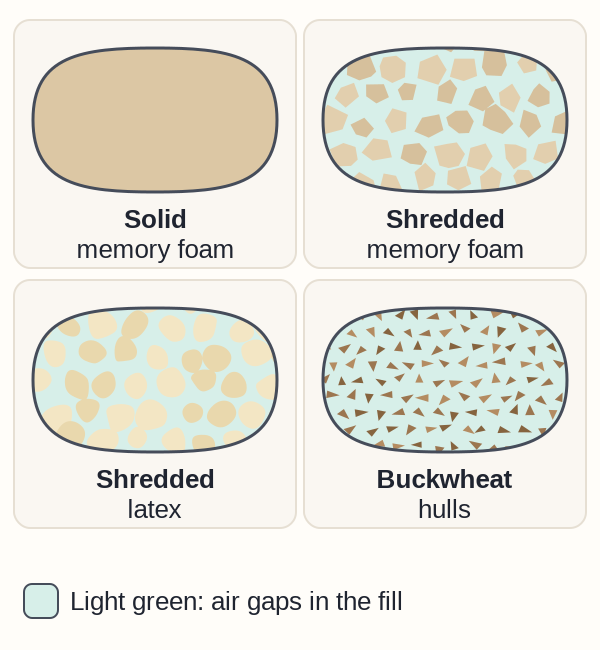
- The fill, first. Loose fills (shredded foam, shredded latex, hulls) leave gaps for air. A single solid block doesn’t. This matters more than any “cooling” label.
- A way to adjust the height. A zipper that lets you take fill out means you can fix a pillow that’s too tall without buying another.
- The cover fabric. Check what will actually touch your face. The fabric label tells you more than a marketing name like “cooling fabric”.
- A trial you’ll actually use. Coop offers a 100-night trial and Hullo a 60-night trial; Saatva points to its own returns policy. Check the current terms before you buy, and give a new fill a full week before you judge it.
- Care you’ll keep up with. Latex cores and buckwheat hulls aren’t machine washable. If you want to throw the whole thing in the wash, that narrows the list.
Which pick for which sleeper
Not sure your pillow is the right height now? Start with the simple check for a pillow that’s too high or too low.
- Side sleepers: makers size their tallest options for you (Saatva’s High loft, for example). Pick an adjustable shredded foam pillow kept full, the taller latex option, or a well-filled buckwheat pillow.
- Back sleepers: Saatva puts back sleepers on its lower loft. Any of the three works once the height is adjusted.
- Stomach sleepers: go flattest. An adjustable shredded foam pillow with fill removed is the simplest route (Coop’s own guidance for stomach sleepers is to take fill out); buckwheat can be emptied down too, though it stays firm.
Do memory foam pillows make you hot?
Many do, especially solid ones. They mold closely around your head and leave little room for air, and the Sleep Foundation’s testers found solid memory foam struggles in temperature tests. Not everyone notices it: if you sleep cool anyway or keep a cold bedroom, a memory foam pillow may be perfectly comfortable.
Is gel memory foam cooler?
Gel, copper or graphite added to foam is meant to offset the heat, and the Sleep Foundation suggests hot sleepers who want memory foam look for a cooling design. We didn’t find independent research showing how long that cooling lasts through a night. If you want to try one, judge it at 3 a.m., not when you first lie down, and buy from a seller with a trial period you can actually use. For what each cooling technology does over a night, see do cooling pillows actually work?
Is a latex pillow cooler than memory foam?
Latex is generally more breathable than synthetic foam, according to the Sleep Foundation’s testing notes, and shredding it adds more air gaps. It’s the closest switch for people who want something soft and supportive but not foam.
Does a cooling pillowcase help?
It can help with how the surface feels, and it’s the cheapest change. A cotton percale weave is crisp and matte rather than silky. But a pillowcase can’t change what’s inside: if a solid foam block is trapping heat, you’ll likely still need a different fill. If yours is silk, see whether a silk pillowcase gets hot.
When to look beyond the pillow
If you wake up soaked, not just warm, bedding is unlikely to be the whole answer. Cleveland Clinic advises scheduling a visit with a healthcare provider if night sweats disrupt your sleep (Cleveland Clinic). For sheets and covers that handle sweat better, see the best bedding for night sweats.
If light is waking you as well as heat, see our comparison of sleep masks vs blackout curtains.
How we researched this
This is a research comparison, not a hands-on test. We haven’t slept on these pillows ourselves. We chose picks by situation, checked each product’s current specs on the maker’s own website on November 17, 2026, and leaned on the Sleep Foundation’s published testing notes and the studies linked above. Where a claim is the maker’s (for example “breathable”), we say so. We list no prices because they change; check the seller’s page.
Our picks
Coop Sleep Goods Original Adjustable Pillow
adjustable shredded memory foam pillow
- Best for
- People who love memory foam's sink-in feel and want it with more air gaps
- Why it won
- The fill is cross-cut memory foam blended with microfiber instead of one solid block, and you can add or remove fill to set the height (an extra half pound comes with it). The cover is the maker's Lulltra fabric (60% polyester, 40% bamboo-derived viscose rayon). CertiPUR-US and GREENGUARD Gold certified, machine washable, with a 100-night trial.
- Watch out
- It's still memory foam, and the maker doesn't sell this one as a cooling pillow; it has separate models aimed at hot sleepers. If you run very hot, latex or buckwheat is the bigger change.
- What it beat
- Beat solid memory foam pillows, because shredded foam generally holds less heat than a solid piece, according to the Sleep Foundation's testing notes, and because you can thin it out.
Saatva Latex Pillow
shredded natural latex pillow
- Best for
- Hot sleepers who want soft, springy support without foam, especially side and back sleepers
- Why it won
- A shredded natural latex core inside a removable layer of down-like microdenier fiber, all in an organic cotton cover. Two heights: Standard (about 4–5 inches) for back and stomach sleepers and High (about 6–7 inches) for side sleepers, per the maker. The maker says natural latex is more breathable than synthetic foams, which matches the Sleep Foundation's testing notes on latex.
- Watch out
- Not for anyone with a latex allergy (the maker says the latex is washed to remove allergy-causing proteins; ask your doctor if you're unsure). The latex core can't be washed, only the cover and fiber layer. The maker suggests replacing it about every 3 years.
- What it beat
- Beat the Coop for hot sleepers because the core is latex rather than foam; lost to the Hullo on airflow, but it's quiet and softer, which suits people who don't want a firm pillow.
Hullo Buckwheat Pillow
buckwheat hull pillow
- Best for
- People who run very hot, like firm, moldable support, and don't mind some rustling
- Why it won
- Buckwheat hulls leave air pockets between them, which the Sleep Foundation credits with preventing heat retention. You add or remove hulls through a zipper to set the height and firmness. Organic cotton twill cover, made in the USA, 60-night trial.
- Watch out
- Heavy (the standard size is listed at 9 lb 12 oz) and firm, and hulls make a rustling sound when you move. Washing the cover means emptying out the hulls first.
- What it beat
- Beat every foam option on airflow; lost the top spot for most readers because the weight, firmness and sound put many people off.
Brooklinen Classic Percale Pillowcase Set
cotton percale pillowcases
- Best for
- Anyone not ready to replace the pillow yet, or as the first, smallest change
- Why it won
- 100% long-staple cotton in a 270-thread-count percale weave, which the maker describes as cool, crisp and breathable. Machine washable, OEKO-TEX certified, in standard, king and Euro sizes, sold as a set of two.
- Watch out
- A pillowcase can't change what's inside. If a solid foam block is trapping heat under your head, the case alone may not be enough.
- What it beat
- Picked over buying a new 'cooling' pillow first: it's the smallest change, and it tells you whether the surface or the fill is the problem.
Watch
- Memory foam pillow too hot? Look at what's inside it (YouTube Short, 0:30)
Sources
- Best Cooling Pillows (testing notes on memory foam, shredded foam, latex and buckwheat; updated Oct 26, 2026), Sleep Foundation
- Forty-Year-Old Foam Springs Back With New Benefits (Spinoff 2005), NASA
- Effects of thermal environment on sleep and circadian rhythm (Okamoto-Mizuno & Mizuno, 2012), Journal of Physiological Anthropology, via PubMed Central
- Effects of head cooling on human sleep stages and body temperature (Okamoto-Mizuno et al., 2003), International Journal of Biometeorology
- Local body cooling to improve sleep quality and thermal comfort in a hot environment (Lan et al., 2018), Indoor Air
- Healthy Sleep Habits, National Heart, Lung, and Blood Institute (NIH)
- Night Sweats, Cleveland Clinic