Best Bedding for Night Sweats: What the Research Says
This guide contains affiliate links. We may earn a commission if you buy through them, at no extra cost to you. How that works.
In short
The best bedding for night sweats is light and layered: a breathable sheet against your skin (linen or cotton percale), a thin top layer you can push off when you overheat and pull back when the sweat stops and you feel cold, and a spare pillowcase within reach. Research on sheet fabrics is thin. One small nap study favored linen over cotton, so choose by feel and care, not by cooling claims.
The short answer
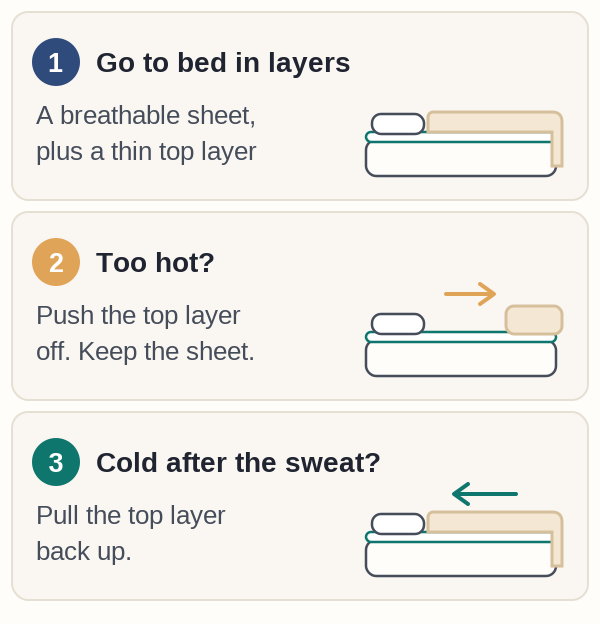
The best bedding for night sweats is light and layered. Put a breathable sheet against your skin (linen or cotton percale), add one thin top layer you can push off when you overheat and pull back when you cool down, and keep a spare pillowcase by the bed. Skip heavy comforters and sateen weaves.
Be wary of anyone who claims more than that. We found exactly one sleep study that compared sheet fabrics, and it was a two-hour nap with eight young men. Below: why night sweats are hard on bedding, what that small body of research does and doesn’t show, how linen, cotton, wool, lyocell and “performance” sheets compare, and how to set up the bed so it works with you through the night.
Why night sweats are a bedding problem twice over
Night sweats aren’t the same as a warm room. The NHS draws the line simply: “It’s normal to sweat during the night if the room or your bedding is making you too hot.” Night sweats are when “your night clothes and bedding are soaking wet, even though where you’re sleeping is cool” (NHS). Cleveland Clinic says they can “soak through your clothes and bedding and wake you up” (Cleveland Clinic).
That causes two problems, one after the other.
- First, you’re hot and wet. Sweat cools you only if it can evaporate. A review of the research on heat and sleep explains that in humid conditions it can’t: higher humidity “does not allow the sweat to evaporate, causing the skin to remain wet” (Okamoto-Mizuno & Mizuno, 2012). The air trapped under your covers, which the review calls the “bed climate,” has its own temperature and humidity.
- Then you’re cold. Cleveland Clinic notes that “when the sweating stops, you may feel cold.” The same review warns about this chill too: when the room is cooled later in the night, “drying off the sweat and changing clothing are essential to avoid chilling effects.”
So the goal isn’t the coldest bed possible. It’s a bed you can adjust in seconds, in both directions, half asleep.
What the research says about sheet fabrics
Less than the “cooling sheets” aisle suggests.
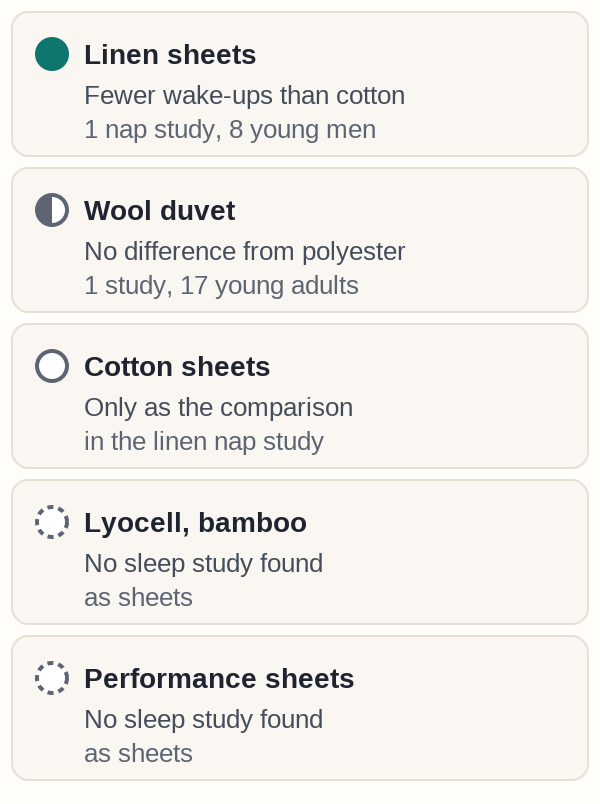
A 2024 systematic review searched six databases for studies that compared people’s sleep on at least two fiber types of bedding or sleepwear. It found nine. Most were about pajamas. Only one compared sheets (Li, Halaki & Chow, 2024).
- Linen sheets. In that one sheet study, eight healthy young men took two-hour daytime naps in a lab at about 84°F (29°C) and 70% humidity. On cotton sheets with a polyester bed pad, they woke up more often, and spent more time in the lightest stage of sleep, than on linen sheets, a linen pad and linen pillowcases. Nothing else measured was different. The review’s summary: “Linen bedsheets improved sleep quality under warm conditions in young adults.”
- Wool vs polyester duvets. In a study of 17 young adults sleeping overnight at about 63°F and 72°F (17°C and 22°C), the authors found “no bedding effect on sleep” (Shin et al., 2016).
- Lyocell, bamboo and performance polyester sheets. We found no sleep study that tests them as sheets.
A few caveats matter here. The linen study was tiny, short and done in daytime, and the review itself says naps “may not be representative of night-time sleep.” The original paper is in Japanese, so we read it only through the review. The people in these studies were healthy; none were studied for night sweats. And the review’s authors note that “a systematic comparison of fibre types is challenging”; two of them have received funding from Australian Wool Innovation, a wool industry body, as did the wool duvet study.
Linen, percale, wool, lyocell or performance: how they compare
With so little sleep research, most of what you’ll read about each fabric is the maker’s claim or an editor’s judgment. Here’s each one, with who says what.
- Linen. The only sheet fabric with a sleep study result in its favor, though a small one. Expect a textured, relaxed feel and, with new sheets, some lint at first (Parachute says so on its own page).
- Cotton percale. The Sleep Foundation’s cooling-sheets guide says “a percale weave allows greater breathability,” while sateen sheets “tend to feel heavier and trap more heat” (Sleep Foundation). Percale is crisp, easy to wash and widely sold. The weave matters more than the thread count, the same page says.
- Wool. Mostly sold as a comforter or mattress pad, not as sheets. The one wool duvet study found no difference from polyester. Wool sleepwear did a little better in an industry-funded study of adults aged 50 to 70 sleeping at 86°F (30°C): they fell asleep faster in wool than in cotton or polyester, a “small” benefit by the authors’ own word (Chow et al., 2019). That’s pajamas, not bedding.
- Lyocell (TENCEL) and bamboo-derived fabrics. Smooth and drapey. The Sleep Foundation lists both among fabrics for hot sleepers. Cooling and moisture claims come from fiber and fabric tests, not sleep studies. One maker we checked, Buffy, says outright that its moisture figure is “not a finished-sheet measurement.”
- Performance (athletic-style polyester) sheets. Here the advice splits. The International Hyperhidrosis Society suggests “quick-drying bedding” instead of “the usual cotton sheets,” and says some sheets use “the same material that athletes wear” (International Hyperhidrosis Society). Note that its post profiles a sheet maker and includes a discount code. A psychologist quoted by the Sleep Foundation says “synthetic fibers tend to be less breathable and trap more heat at night.” Neither side cites a sleep study of sheets.
Our read: if you’re starting from scratch, cotton percale is the safe, easy default, and linen is worth it if you like the feel. Lyocell suits people who want smooth. Performance sheets are a reasonable thing to try if natural fibers stay damp on you, but nobody has shown they help you sleep.
Build the bed in layers
Health sources agree on layers, even where they say little about fabric. The National Institute on Aging suggests you “layer your bedding so it can be adjusted as needed and turn on a fan” (NIA). Cleveland Clinic’s at-home list includes “lightweight, layered bedding that you can remove as needed at night.”
A setup that does that:
- Bottom: a breathable fitted sheet (linen or percale).
- Next to you: a flat sheet, or nothing if even a sheet feels like too much.
- Top: one thin layer you can push off without waking fully, such as a lightweight comforter, a cotton blanket or a quilt. Two thin layers give you more options than one thick one, because you can take off one at a time.
- Within reach: a spare pillowcase or a folded towel to lay over a damp patch, so you don’t have to strip the bed at 3 a.m.
- The room: cool, with a fan if you like moving air. NIA suggests lowering the bedroom temperature.
Check what’s under you, too. A foam mattress or topper can hold heat from below; see what to do when a memory foam topper is too hot. For your head, see whether cooling pillows work, why a silk pillowcase can feel hot and what to do when a memory foam pillow is too hot. And if your partner is cold while you’re soaked, don’t fight over one comforter: see the two-duvet fix.
What is the best fabric for night sweats?
No study has crowned one. For sheets, linen has the only (small) study result in its favor, and cotton percale is the easy, widely recommended default. More important than the fiber: a light, open weave rather than sateen, and a top layer thin enough to push off.
Do linen sheets help with night sweats?
They haven’t been tested on people with night sweats. In the one lab study we found, young men napping in warm, humid conditions woke up less on linen than on cotton. That’s encouraging for comfort, not proof that linen does anything for night sweats themselves.
What should I wear to bed if I have night sweats?
Cleveland Clinic suggests “loose-fitting, lightweight, cotton or linen pajamas.” Keep a dry spare set by the bed, so a change doesn’t mean turning on the light and hunting through drawers.
Why am I sweating through my sheets every night?
Bedding can make you warm, but if your sheets are soaked even in a cool room, the NHS describes that as a night sweat rather than ordinary overheating, and it has many possible causes. That’s a question for a provider, not a sheet maker (see below).
When to look beyond the bedding
Better bedding is a comfort fix. It doesn’t treat anything. Night sweats can have medical causes, including medicines and other health conditions. Cleveland Clinic’s advice is clear: “Schedule a visit with a healthcare provider if you have night sweats that disrupt your sleep” (Cleveland Clinic). The NHS also lists signs that mean you should get checked, such as night sweats that keep happening, come with a high temperature, or come with weight loss you can’t explain (NHS).
How we researched this
This is a research comparison, not a hands-on test. We haven’t slept on these sheets or this comforter ourselves. We read the systematic review and the studies linked above in full, except the linen nap study, which we read only through the review’s summary. We read guidance from Cleveland Clinic, the NHS and the National Institute on Aging, and we say where research doesn’t exist. We checked each product’s materials, sizes, care and return terms on the maker’s own website on November 18, 2026. Where a claim is the maker’s, such as a room-temperature range or a cool-to-the-touch reading, we say so. We list no prices because they change; check the seller’s page.
Our picks
Parachute Linen Sheet Set
linen sheet set (100% European flax)
- Best for
- Readers who want linen, the one sheet fabric with a sleep study behind it, and like a relaxed, textured feel
- Why it won
- 100% European flax at 175 GSM, made in Portugal, OEKO-TEX Standard 100 certified. The set is a fitted sheet, a top sheet and a pillowcase set; the fitted sheet fits mattresses up to 16 inches deep. Machine washable. The maker recommends it 'for warm or cool sleepers.'
- Watch out
- The maker says to expect lint in the dryer at first, easing after about five washes. When we checked, this set came in Full, Queen, King and Cal King only. Returns within 60 days; shipping and handling fees aren't refunded. The linen study behind our pick was small and short (see below), so don't expect a guarantee.
- What it beat
- Beat cotton percale for readers who want the fabric that came out ahead in a sleep study, small as it was; lost to percale for readers who want a smooth, crisp feel at a much lower list price.
Brooklinen Classic Percale Core Sheet Set
cotton percale sheet set
- Best for
- Most people: a plain, breathable cotton sheet that goes in the washer and dryer
- Why it won
- 100% long-staple cotton in a 270-thread-count percale weave. The maker pitches it squarely at hot sleepers ('Hot sleepers, these cooling sheets are just for you'). A fitted sheet, flat sheet and two pillowcases (one in Twin and Twin XL), in every size from Twin to Cali King; the fitted sheet fits mattresses up to 16 inches deep. Machine wash cold, tumble dry low. OEKO-TEX Standard 100 certified.
- Watch out
- Mattresses deeper than 16 inches won't fit. Returns are accepted for 365 days, but a return fee comes out of the refund. The same brand sells a sateen version; for night sweats, make sure you pick the percale.
- What it beat
- Picked over sateen weaves because the Sleep Foundation says sateen tends to 'trap more heat'; lost the top spot to linen only for readers who want the fabric with the sleep-study result.
Buffy Breeze Sheet Set
TENCEL lyocell sheet set (from eucalyptus)
- Best for
- People who find linen too rough and percale too crisp, and want something smooth
- Why it won
- 100% TENCEL lyocell. The maker reports a cool-to-the-touch reading (Qmax 0.405, tested by Intertek) and says lyocell absorbed more moisture than cotton in a fiber test, noting it was 'not a finished-sheet measurement.' OEKO-TEX Standard 100 Class I. Machine wash cold, tumble dry low. A 7-night at-home trial before you're charged, plus 50-night returns.
- Watch out
- Fitted sheets are 15 inches deep (12 inches in Twin and Twin XL), shallower than the other two sets here. We found no sleep study of lyocell sheets, and a cool-to-the-touch number describes the first touch, not 3 a.m. The page also makes skin and hair claims we didn't evaluate.
- What it beat
- Picked as the smooth option because the maker says plainly what its numbers measure; lost to linen and percale because no sleep study backs lyocell sheets.
Woolroom Deluxe Washable Wool Comforter (Light)
lightweight wool comforter (the top layer)
- Best for
- A thin top layer you can push off and pull back, from a maker that gives a room-temperature range
- Why it won
- 200 gsm British wool fill in a 200-thread-count organic cotton shell, with no synthetic fibers. The maker says it suits room temperatures of 68°F and up, and pitches it at 'warm sleepers and night sweat sufferers.' Twin (66 x 86 inches), Queen/Full and King, with corner ties for a duvet cover. Machine washable on a wool or delicate cycle. OEKO-TEX Standard 100 certified; 30-night trial.
- Watch out
- Line dry only, no tumble dryer. The maker treats the wool with a chlorine solution to make it washable. The one sleep study of wool duvets found no difference from polyester, and it was funded by the wool industry.
- What it beat
- Picked as the top layer because the maker gives a room-temperature range and it washes at home; lost to a light blanket you already own if all you need is something to peel off.
Watch
- Night sweats? The second half nobody shops for (YouTube Short, 0:28)
Sources
- Night Sweats (last updated Apr 28, 2026), Cleveland Clinic
- Night sweats, NHS
- Hot Flashes: What Can I Do?, National Institute on Aging (NIH)
- How do sleepwear and bedding fibre types affect sleep quality: A systematic review (Li, Halaki & Chow, 2024), Journal of Sleep Research, via PubMed Central
- The effects of fabric for sleepwear and bedding on sleep at ambient temperatures of 17°C and 22°C (Shin et al., 2016), Nature and Science of Sleep
- The impact of sleepwear fiber type on sleep quality under warm ambient conditions (Chow et al., 2019), Nature and Science of Sleep
- Effects of thermal environment on sleep and circadian rhythm (Okamoto-Mizuno & Mizuno, 2012), Journal of Physiological Anthropology, via PubMed Central
- Best Cooling Sheets of 2026 (updated Nov 6, 2026), Sleep Foundation
- Wicked Sheets & Night Sweats, International Hyperhidrosis Society