Memory Foam Topper Too Hot? Wool, Latex or Something Else
This guide contains affiliate links. We may earn a commission if you buy through them, at no extra cost to you. How that works.
In short
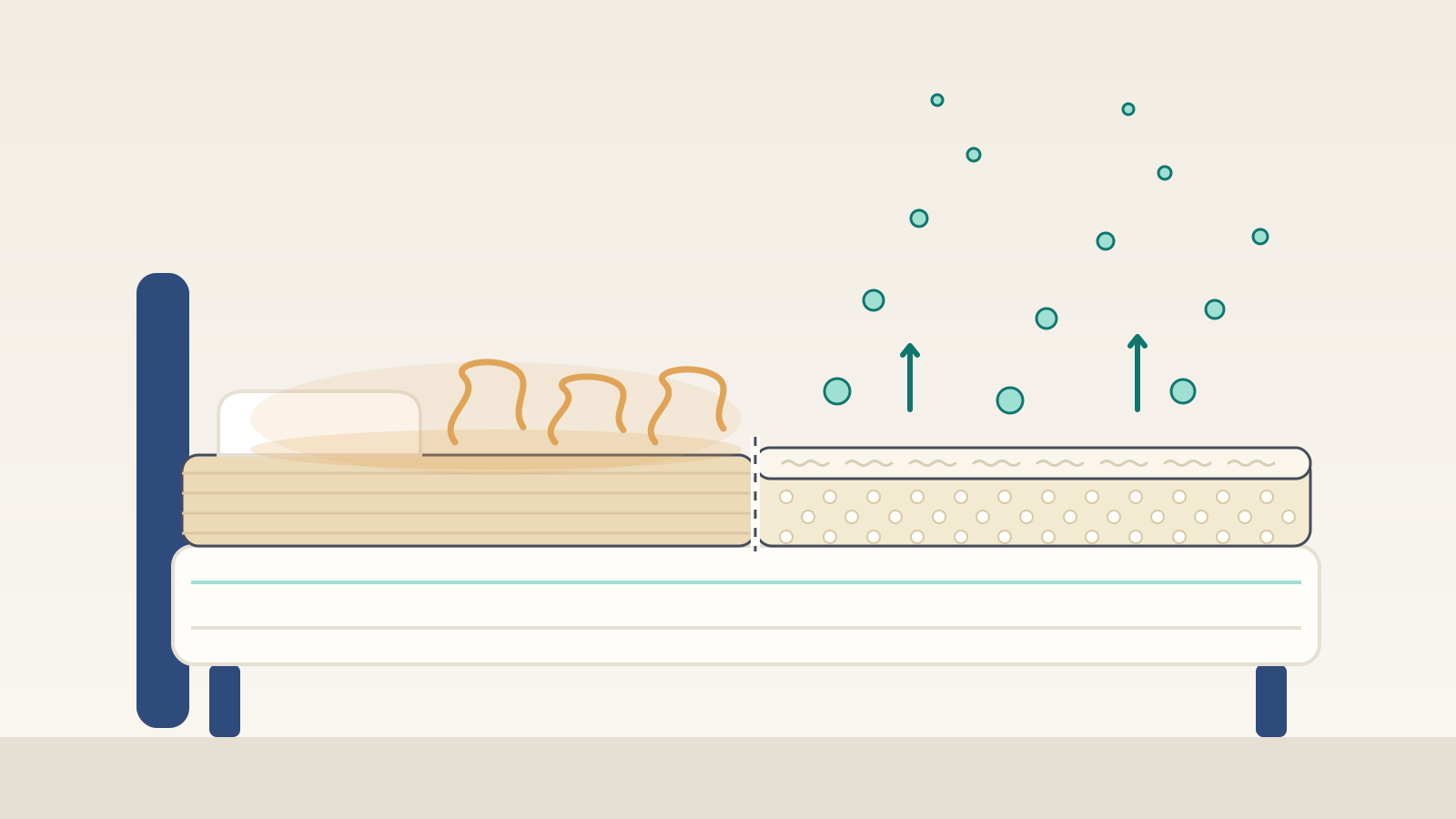
A memory foam mattress topper usually sleeps hot because you sink into it: the foam hugs your body, moves little air, and holds your heat close. If you want to replace it, latex and wool are the usual switches: latex because you rest on it rather than in it, wool because it takes up moisture. Gel 'cooling' foam is the weakest bet: the Sleep Foundation's testing found no clear sign that gel makes a difference. Before you buy anything, check your mattress protector and sheets.
The short answer
If your memory foam mattress topper is too hot, the usual reason is that you sink into it. The foam hugs your body, little air moves around you, and your own heat stays close. The two common switches are latex, which you rest on rather than in, and wool, which takes up moisture. A gel “cooling” foam topper is the weakest bet: the Sleep Foundation’s own testing found no clear proof that gel makes a difference.
Below: why foam toppers sleep warm, a quick check before you spend anything, how wool, latex and “cooling” foam compare, what the research does and doesn’t show, and which one fits which sleeper.
Why a memory foam topper sleeps hot
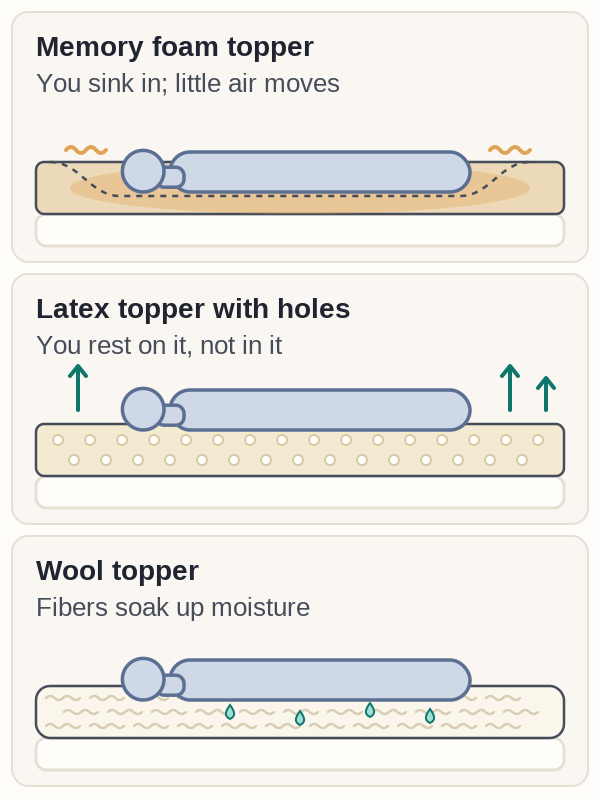
The Sleep Foundation puts it bluntly: “Memory foam is notorious for trapping body heat. Its density makes it less breathable than other materials, while its body-hugging properties make it more likely to absorb and contain the body heat of the sleeper” (Sleep Foundation). Because it lets you sink deep, “surface airflow is also limited” (Sleep Foundation).
With a topper, that foam is the layer right under you, and the deeper you sink, the more heat builds up. The Sleep Foundation’s buying guide says a softer surface “allows the body to sink in further and causes more heat to build up around the sleeper,” and that heavier sleepers sink further, “leading to increased heat retention” (Sleep Foundation).
Moisture matters as well as heat. The pocket of air between you and your covers, which researchers call the bed climate, is generally kept around 32–34°C (about 90–93°F) and 40–60% relative humidity “when normal sleep is obtained,” according to a review of the research (Okamoto-Mizuno & Mizuno, 2012). The same review notes that “humid heat exposure further increases thermal load during sleep,” so a layer that holds damp as well as warmth close to you works against you twice.
If it’s your head that runs hot, not your whole body, the pillow is the likelier culprit: see what to do when a memory foam pillow is too hot.
Before you buy: a quick check tonight
- When you wake up warm, put a hand on the topper where you were lying, then on a part nobody touched. Is your spot clearly warmer, or damp?
- Look at what’s on top of the topper. A waterproof protector, a thick quilted pad or flannel sheets all add layers between you and the air. The Sleep Foundation notes flannel sheets are “thicker and warmer than breathable cotton percale sheets.”
- Look under the mattress. If it sits on the floor, the Sleep Foundation suggests a foundation or slatted frame for airflow.
- Ask where you’re hot. Back and hips against the bed points to the topper. Head only points to the pillow. Hot all over, under the covers too, points to the room and the duvet. NHLBI’s advice is a bedroom that’s “quiet, cool, and dark” (NHLBI).
If steps 1 and 4 point to the topper and steps 2 and 3 turn up nothing to fix, it’s time to change the topper. If you run hot and your partner runs cold, the topper may not be the whole answer: see the two-duvet fix for hot and cold sleepers.
Wool vs latex vs gel foam: how they compare
| Plain memory foam | Gel or “cooling” memory foam | Latex | Wool | |
|---|---|---|---|---|
| Heat (Sleep Foundation) | “Known for trapping heat” | “The jury is out” on whether gel works | Breathable, open-cell; keeps you “on” not “in” the bed | “Wicks moisture away from the body” |
| Feel | Close-conforming hug | “Good conforming” | Springy, “a looser cradle” | Depends on thickness (our pick: 1.5 in) |
| Holes or vents | Not stated | Not stated | “Many” are ventilated with small holes | n/a (loose fibers) |
| Lifespan (Sleep Foundation) | A low-quality one can dent “before the year is out” | Not stated | About 3 to 4 years | About 3 to 4 years |
| Care (our picks) | Varies by model | Varies by model | Avocado: spot clean, cover sewn shut | Sleep & Beyond: spot clean and air it out |
Unless marked as our picks, every cell comes from the Sleep Foundation’s cooling topper buying guide and its gel memory foam explainer. “Not stated” means neither says.
What the research shows (and what it doesn’t)
We couldn’t find a single study that puts wool, latex and memory foam toppers side by side and measures heat. A 2024 systematic review of bedding fibers and sleep left mattresses out on purpose, and for duvets it found no significant difference between wool and polyester (Li et al., 2024). Here is what does exist:
- An airy topper vs a memory foam topper. In a randomized crossover study of 10 young and 20 older men, a 3.5 cm (about 1.4 inch) topper made of woven polyethylene fibers that let air through was compared with a memory foam topper of the same thickness. On the airy topper, core body temperature fell further early in the night (in the young men, a low of 36.05 vs 36.35°C) and deep sleep rose in that first stretch (Chiba et al., 2018). The maker of the airy topper sponsored the study, the samples were small, and the room was kept at about 25–26°C (77–79°F) at lights out.
- A heat-absorbing layer vs a memory foam mattress. In 72 adults across three sleep labs, a mattress whose top 2 cm was coated in dense polyurethane to soak up more heat added an average of 7.5 minutes of deep sleep over the night and lowered heart rate by about 2 beats per minute, compared with a regular memory foam mattress (Herberger et al., 2024). One author works for the company that makes that mattress, and it’s a dense coating, not the gel particles mixed into most “gel” foam.
- A cooling topper in a hot room. In 15 healthy young adults, a topper built to conduct heat away gave about 21 more minutes of sleep than a control topper on a night at 32°C (about 90°F), but sleep length didn’t differ at 22°C (about 72°F) (Pasquier et al., 2025).
- The bigger picture. A meta-analysis of nine trials of cooling bedding found no clear effect on sleep measures, with evidence of “very low to low” certainty, though the studies did suggest the bedding cooled the body (Pasquier et al., 2025).
The fair reading: what a topper is built from can change how much body heat gets away, and it seems to matter most on hot nights. Nobody has shown that one topper material will fix every hot sleeper.
What to look for in a cooler topper
- How it’s built, before any label. The Sleep Foundation says the most straightforward route is “materials that allow for airflow”: latex, open-cell or convoluted foam, and cotton or wool covers. Infusions like gel, copper or graphite are what makers use for materials “inherently prone to retaining heat.”
- Firmer, not softer. The less you sink, the less heat builds around you. “If you find you run hot, you may want to consider getting a firmer mattress topper,” the Sleep Foundation advises.
- Holes, coils or loose fibers. The Sleep Foundation says ventilated latex and convoluted or aerated foam are designed for more air circulation. A coil layer or a loose wool fill also swaps solid foam for a more open structure.
- The cover fabric. Check what’s actually on the label. Cotton and wool tell you more than a name like “cooling fabric.”
- A trial you can use. Terms differ a lot: Avocado gives 100 nights, Helix 120, The Woolroom’s protector 30, and Sleep & Beyond takes back only unused toppers. Judge a new topper at 3 a.m., not when you first lie down.
Which topper for which sleeper
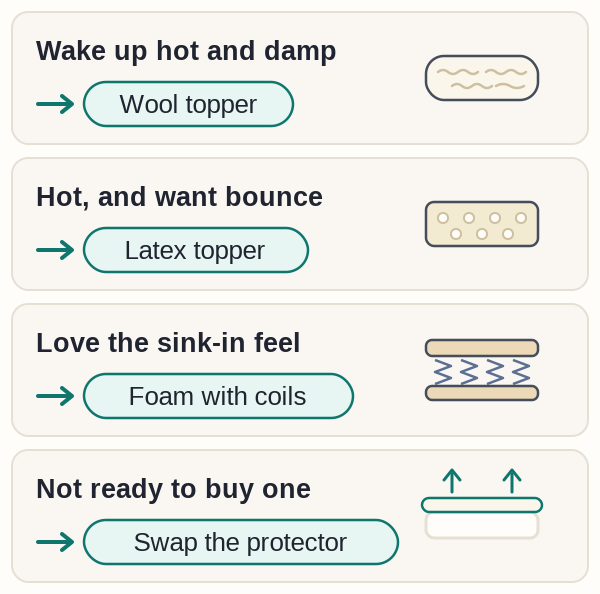
- You wake up hot and damp: wool. A review of wool science says wool “has the ability to absorb and release moisture without feeling damp” and can hold water “up to approximately one-third of its weight” (Zhou et al., 2025). That review is about the fiber in general, mostly clothing, not toppers.
- You run hot and want cushioning with bounce: latex. Side sleepers usually want a plusher, thicker topper for the hips and shoulders, and stomach sleepers a firmer, thinner one, according to the Sleep Foundation.
- You love foam’s feel: a foam topper that swaps part of the foam for coils, or an open-cell or convoluted foam, rather than a solid gel slab.
- You’re not ready to buy a topper: take off any waterproof protector, try a breathable wool protector and cotton percale sheets, and see if that’s enough.
One thing to check after any change: a new topper changes how far your shoulder sinks, which can make your pillow feel too high or too low. Here’s the simple check for pillow height.
Why does my mattress topper make me feel hot?
Most often because it’s memory foam that lets you sink deep, so it hugs your body and limits airflow around you. A soft topper adds to it, and so can extra layers on top, like a waterproof protector, a thick pad or flannel sheets.
Do cooling mattress toppers actually work?
Some help, but it depends on what “cooling” means. Toppers built to let air through, like latex or coil layers, have a design reason to sleep cooler. For gel, the Sleep Foundation’s testing found all-foam gel mattresses rated only “fair” or “good” for temperature, “comparable to most standard memory foam models,” and it says gel “appears to offer minimal, if any, cooling benefit” (Sleep Foundation). Its tests were of mattresses, not toppers, but the material is the same.
Is latex or wool better for hot sleepers?
Neither wins outright, and no study has tested them against each other. Latex is the better pick if you want real cushioning and support without foam’s sink. Wool is the better pick if dampness wakes you up and you’re happy with a thinner layer. Some toppers combine the two: Sleep & Beyond sells a wool-and-latex topper, and the Sleep Foundation’s list includes one with wool over Talalay latex.
Can you put a cooling topper on a memory foam mattress?
Yes. The Sleep Foundation’s advice for a hot memory foam bed starts with bedding: a cooling topper, a pad or new sheets. A topper changes the surface, though, not what’s underneath, and it “can’t add support to a sagging mattress.” If you’ve tried the fixes without much success, or the bed is 6–8 or more years old, the Sleep Foundation says it may be time for a new mattress.
When to look beyond the bed
If you wake up soaked, not just warm, bedding is unlikely to be the whole answer. Cleveland Clinic advises you to “schedule a visit with a healthcare provider if you have night sweats that disrupt your sleep” (Cleveland Clinic). For sheets and covers that handle sweat better, see the best bedding for night sweats, and for the head end of the bed, do cooling pillows actually work?.
How we researched this
This is a research comparison, not a hands-on test. We haven’t slept on these toppers ourselves. We read the studies above in full where they’re open access, and only the abstracts of the two by Pasquier and colleagues. We leaned on the Sleep Foundation’s published testing notes for how materials compare, and we say where the research has no answer. We checked each product’s specs, trial and care terms on the maker’s own website on November 18, 2026. Claims such as “cooling” or “breathable” are the makers’ unless we say otherwise. We list no prices because they change; check the seller’s page.
Our picks
Sleep & Beyond myMerino Topper
organic merino wool mattress topper
- Best for
- Hot sleepers who wake up clammy and want a natural layer on the mattress they already have
- Why it won
- A 1.5-inch layer of certified organic superfine merino wool (the maker lists 1,500 GSM of fill) in a 270-thread-count organic cotton percale cover, GOTS-certified, with a 5-year warranty, according to the maker. Wool fiber absorbs and releases moisture, which suits people whose problem is a damp, sticky bed as much as heat.
- Watch out
- At 1.5 inches it's thinner than the 2 to 4 inches the Sleep Foundation says most toppers measure, so don't expect deep cushioning. Spot clean only, and the maker says the wool smell fades within a few days. Returns are for new, unused items only, within 30 days: once you've slept on it, it's yours.
- What it beat
- Beat The Woolroom's Wooly Mattress Topper (wool over microcoils, 3–4 inches) for readers who want a plain wool layer; the Wooly's 100-night trial only applies if you also buy the maker's mattress protector. Lost to the latex pick for anyone who needs real cushioning or a trial.
Avocado Eco Organic Mattress Topper
natural latex mattress topper (organic Dunlop or Talalay)
- Best for
- Hot sleepers who still want cushioning, with bounce instead of memory foam's slow sink
- Why it won
- Comes 2 or 3 inches thick, in Medium (GOLS-certified organic Dunlop latex) or Plush (FSC-certified Pure Talalay latex), inside an organic cotton cover, per the maker. GOTS, GREENGUARD Gold and OEKO-TEX Standard 100 Class I certified, with a 100-night trial (limited to one topper) and a 1-year warranty. The Sleep Foundation describes natural latex as a breathable, open-cell material that keeps you 'on' rather than 'in' the bed.
- Watch out
- It's latex: the maker calls it hypoallergenic, but if you have a latex allergy, ask your doctor first. It's heavy (the 3-inch Medium queen is listed at 46 lbs). The cover is sewn shut and the topper is spot clean only. The page doesn't say the latex is ventilated with holes, which some latex toppers are.
- What it beat
- Beat 'cooling' memory foam toppers for hot sleepers, because latex's case rests on how it's built rather than on an additive; lost to the wool pick for people whose main problem is waking up damp rather than hot.
Helix Premium Mattress Topper with GlacioTex
foam and microcoil topper with a cooling cover
- Best for
- People who like foam's cushioning and don't want latex or wool
- Why it won
- A 3-inch topper of five layers, foams plus a layer of microcoils, in Luxury Plush or Luxury Firm, according to the maker. The GlacioTex cover is described by the maker as a heat-conductive fabric that feels cool to the touch. CertiPUR-US and GREENGUARD Gold certified foams, no-slip straps, a 120-night trial and a 1-year warranty. The Sleep Foundation's testers named it their best overall cooling topper.
- Watch out
- The cover's cooling is the maker's claim, and we found no independent research on how long a cool-to-the-touch fabric helps through a whole night. It's still foam on top, so the hottest sleepers may do better with latex or wool. The warranty is only 1 year.
- What it beat
- Beat gel- and graphite-infused memory foam toppers, because part of its depth is coils rather than solid foam, and the Sleep Foundation's testing found no clear cooling benefit from gel; lost to latex and wool for people who run very hot.
Woolroom Deluxe Washable Wool Mattress Protector
wool mattress protector
- Best for
- The first, smallest change, before you buy a new topper
- Why it won
- A half-inch layer of machine-washable British wool (7 oz per square yard) in a 200-thread-count organic cotton cover, with an 18-inch deep elastic skirt, per the maker. OEKO-TEX Standard 100 certified, with a 30-night trial. It goes over the mattress or topper you already have, in place of the protector on it now.
- Watch out
- The maker says it 'will take away up to 70% of the heat given off'; we found no independent test behind that number, so don't count on it. The page doesn't call it waterproof, so it won't stop spills like a waterproof protector. Wash on a wool cycle and line dry only.
- What it beat
- Picked over buying a new topper first: it's the smallest change, and it tells you whether the surface layer is the problem before you replace the topper.
Watch
- Memory foam topper too hot? You're sinking into it (YouTube Short, 0:24)
Sources
- How to Make a Memory Foam Mattress Sleep Cooler (updated Jul 15, 2025), Sleep Foundation
- Does Gel Memory Foam Really Sleep Cool? (updated Jul 15, 2025), Sleep Foundation
- Best Cooling Mattress Toppers (buying guide and testing notes; updated Nov 4, 2026), Sleep Foundation
- High rebound mattress toppers facilitate core body temperature drop and enhance deep sleep in the initial phase of nocturnal sleep (Chiba et al., 2018), PLOS ONE
- Enhanced conductive body heat loss during sleep increases slow-wave sleep and calms the heart (Herberger et al., 2024), Scientific Reports
- Protective Effect of a High Heat Conductivity Mattress Topper on Sleep During Heat Night (Pasquier et al., 2025), Journal of Sleep Research
- Does body cooling facilitated by bedding compared to control condition improve sleep among adults (18–64 years old)? A systematic review and meta-analysis (Pasquier et al., 2025), Journal of Thermal Biology
- How do sleepwear and bedding fibre types affect sleep quality: A systematic review (Li, Halaki & Chow, 2024), Journal of Sleep Research, via PubMed Central
- Wool: From Properties and Structure to Genetic Insights and Sheep Improvement Strategies (Zhou et al., 2025), Animals (MDPI), via PubMed Central
- Effects of thermal environment on sleep and circadian rhythm (Okamoto-Mizuno & Mizuno, 2012), Journal of Physiological Anthropology, via PubMed Central
- Healthy Sleep Habits, National Heart, Lung, and Blood Institute (NIH)
- Night Sweats, Cleveland Clinic