Electric Blanket vs Heated Mattress Pad: Which to Choose
In short
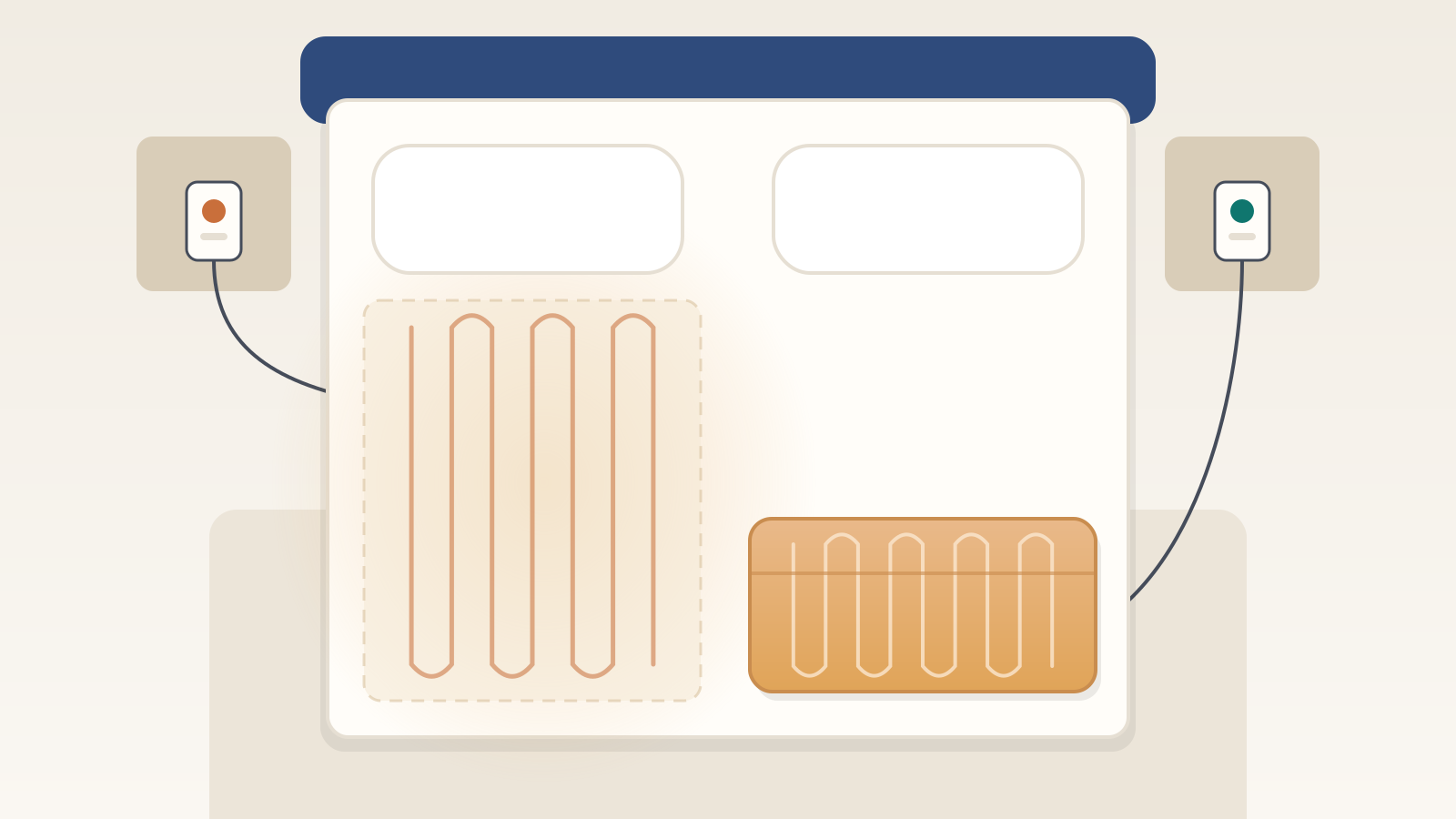
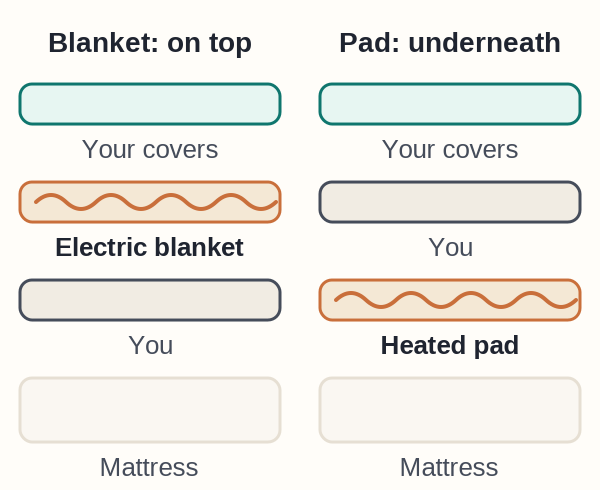
A heated mattress pad lies on the mattress and warms you from below, so it stays put all night; an electric blanket goes on top, where you can push it off and take it to the couch. Pick the pad for steady warmth, the blanket for flexibility. Either way, use it to warm the bed, then turn it off before you sleep (UL's tip), or make sure it has an auto shut-off (Electrical Safety First).
The short version
A heated mattress pad lies on the mattress and warms you from below. It stays where it is all night, and some models have a separate control for each side. An electric blanket goes on top of you. You can push it off when you get warm, and you can carry it to the couch.
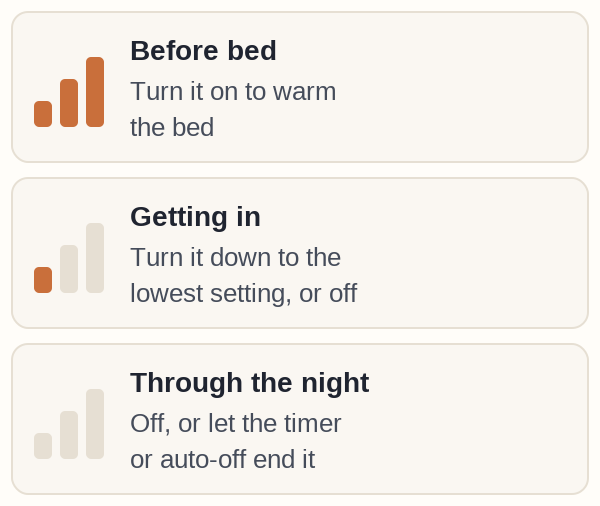
So the pad is the pick for steady warmth in bed, and the blanket is the pick for flexibility. Whichever you choose, the safety lab UL’s guidance, citing a burn surgeon, starts with this tip: “Use the blanket to heat up the bed — then turn it off before you go to sleep” (UL Solutions). If you do keep heated bedding on, make sure it has an automatic shut-off (Electrical Safety First).
The rest of this guide covers which one keeps you warmer, what the sleep studies found, what each costs to run, and what to check before you buy and every winter after.
Electric blanket vs heated mattress pad at a glance
| Electric blanket | Heated mattress pad | |
|---|---|---|
| Where it goes | On top of you | On the mattress, under you |
| Stays in place at night | Can be pushed off or slide | Stays put |
| Couch or chair use | Yes | No, bed only |
| Easy to cool down | Push it off | Turn it down or off |
| A control for each side | On some models | On some models |
| Washing | Sunbeam’s are machine washable with the controller removed; check your label | Same |
| Memory foam mattress | Check the mattress maker’s rules first | Check the mattress maker’s rules first |
| Typical wattage (one maker’s current range) | 100–110 W | 100–110 W (mostly 110 W) |
The wattage row comes from one maker’s current spec pages, Sunbeam’s, which list 100 to 110 watts for its blankets and mostly 110 watts for its pads (blanket, pad). Other brands differ, so read the label on the one you’re looking at.
Which one keeps you warmer?
No study we found compares the two head to head, so we can’t tell you one is measurably warmer.
What is known is that bedding matters. A 2012 review of sleep and temperature says that when people sleep normally, the air in the bed under the covers usually sits around 32–34 °C (about 90–93 °F) at 40–60% humidity, and that bed covers are what let that warm pocket build up (Okamoto-Mizuno & Mizuno). Both products add heat to that pocket. The practical difference is control:
- A pad keeps working when you move. You can’t kick it off in your sleep, which is good if you’re cold all night and less good if you overheat at 3 a.m.
- A blanket is easy to escape. Push it down and you’re back to your normal covers.
If you share a bed and only one of you is cold, a model with a control for each side lets each person set their own half. Sunbeam’s manual, for example, says each control “warms only one side of the heated item” (Sunbeam manual). If heat is the whole argument between you, separate covers can help too: see two duvets on one bed.
Should you leave it on all night?
The safety advice says no: warm the bed, then turn it off, or use the auto shut-off (UL Solutions; Electrical Safety First). The small amount of sleep research points the same way.
Heat late in the night. In a 1999 Australian study, 16 young adults were heated in bed from 2:30 a.m. until they woke (the paper’s title names an electric blanket). Their core body temperature rose by about 0.18 °C between 4 and 7 a.m., their sleep efficiency fell by about 5.5% between 3:30 and 7:30 a.m., and they spent more time awake and in the lightest sleep stage, with more shifts between stages. Their melatonin didn’t change (Fletcher et al., abstract only). The authors concluded that a warmer core at night “may disrupt sleep.”
Heat in a cold room. A 2005 Japanese study put nine young men to sleep in a room kept at 3 °C (about 37 °F), with and without an electric blanket. With the blanket they had less of the lightest sleep stage, warmer legs and feet, and no extra sweating. The authors suggested a blanket in a very cold room may ease cold stress and help keep sleep stable (Okamoto-Mizuno et al., abstract only).
Slight skin warmth when falling asleep. Dutch lab studies changed skin temperature by less than 1 °C with controlled lab equipment, not a consumer blanket. Slightly warmer skin went with falling asleep a few minutes sooner: about 3 minutes sooner than with slightly cooler skin in eight young adults, and about 2 to 3 minutes sooner in 16 older adults (average ages 59 and 66), half of whom had insomnia (Raymann et al., 2005; Raymann & Van Someren, 2008; both abstract only).
These are small studies, mostly of young adults, and none tested warming a bed before getting in, so they can’t tell you how you’ll sleep. They are consistent with the safety advice, though: slightly warmer skin went with falling asleep sooner, extra heat in the second half of the night went with lighter sleep, and the one blanket study that found a benefit was done in a near-freezing room.
What does each cost to run?
You can work it out yourself: watts ÷ 1,000 × hours × your price per kWh.
Using the US average residential price, 18.16 cents per kWh (EIA, August 2026, a preliminary figure) (EIA), and the wattages above:
- A 110 W pad, 8 hours: 0.88 kWh, about 16 cents a night.
- A 100 W blanket, 8 hours: 0.8 kWh, about 15 cents a night.
- Warming the bed for 30 minutes, then off (110 W): about 1 cent a night.
These use the full rated wattage for every hour, so treat them as the top end. Your own price may be higher or lower than the average; it’s on your bill.
In the UK, where “electric blanket” often means one that fits on the mattress under the sheet, EDF Energy works out a typical 70 W blanket at about 1.84p an hour at 26.32p per kWh (EDF Energy), and Which? puts electric blankets at roughly 2p to 6p an hour to run (Which?).
Which one for which sleeper
- Cold all night, want steady warmth: a heated pad with an auto shut-off you can set for the night.
- Cold at bedtime, too hot by the early hours: a blanket you can push off, or warm the bed first and switch off. If you wake up sweaty, the bedding itself may be the issue: see bedding for night sweats.
- One partner cold, one warm: a pad or blanket with a separate control for each side, or separate covers.
- Memory foam mattress or topper: check the mattress maker’s instructions first. Beautyrest’s, for example, says that if its mattress “contains memory (viscoelastic) foam, do not use a heating pad or electric blanket” (Beautyrest). If memory foam already makes you hot, see why a memory foam topper sleeps hot.
- Couch, armchair, or reading in bed: a blanket. A pad only works on a mattress.
- Sofa bed, pull-out bed or adjustable bed: neither. UL says never to use an electric blanket on these, because the wires can be pinched or frayed (UL Solutions), and Sunbeam’s manual says the same for adjustable beds, bunk beds and waterbeds (Sunbeam manual).
What to check before you buy, and every winter
Before you buy:
- A testing lab’s mark. UL says to use only blankets approved by a nationally recognized testing agency, and explains that the mark means “a representative sample of the blankets has been tested for safety” (UL Solutions).
- New, not secondhand. UL: “Never buy an electric blanket from a secondhand shop or garage sale.”
- An auto shut-off you can set.
- The recall list. Search the brand and model at cpsc.gov/Recalls before you buy. Heated bedding has had several recent recalls and warnings in the US:
- Bedsure heated blankets and heating pads, March 2023: about 350,000 units, a controller that could malfunction, 137 reports of fire, burning, melting or overheating (CPSC).
- Sunbeam queen heated blanket, model 32810027, March 2023: about 43,000 units in the US, 13 reports of overheating (CPSC).
- Melinora heated blankets, July 2026: a CPSC warning to stop using them, after the maker didn’t respond to requests for a recall (CPSC).
- JKMAX heated blankets and heating pads, September 2026: about 195,000 units, 577 reports of smoking, melting or burning and 53 burn injuries (CPSC).
Every winter, before you plug it back in (Electrical Safety First’s checks):
- Replace it if it’s 10 years old or more.
- Look for scorch marks or discoloring, which are likely signs of overheating, and for frayed or damaged wires.
- Store it rolled, not folded, to protect the wiring, and never use it folded or creased, which can make it overheat.
- Never use it with a hot water bottle.
Electrical Safety First counted 31 accidental electric blanket fires in England in 2024/25, a five-year high, with 11 casualties and/or deaths (Electrical Safety First). That is a UK figure, and in the UK “electric blanket” usually means the kind that goes on the mattress, so read the checks as advice for heated bedding in general.
When it’s in use (UL):
- Don’t put bedding or anything else on top of an electric blanket while it’s on.
- Never use it together with a heating pad; heat can build up in the layers and burn.
- Don’t run the cord between the mattress and box spring, or let the bed frame pinch it.
Who should skip heated bedding
UL’s page is about electric blankets, and it says they are not recommended for these groups (UL Solutions):
- Infants and young children.
- Anyone who is paralyzed or can’t understand how to use one safely.
- People with urinary incontinence.
The same page adds that, according to experts, people with diabetes are more vulnerable to burns from electric blankets, because the condition can make them less sensitive to heat. UL doesn’t cover heated pads separately, but a pad also heats the bed you lie on, so the same caution makes sense.
Our own suggestion, not UL’s: if you have diabetes or reduced feeling in your legs or feet, ask your doctor before using heated bedding, and if you feel cold most of the time, mention that to a doctor too.
Is it cheaper to use an electric blanket than to turn up the heat?
It warms you, not the room, so the two aren’t the same job. A heated pad or blanket costs roughly 1 to 16 cents a night at the US average price (see the costs above). Whether that saves money depends on how you heat your home and what you’d otherwise set the thermostat to, and we didn’t find a source that compares the two fairly, so we won’t promise a saving.
Is it healthy to sleep on a heated mattress pad?
For most adults, the safety advice is to use it to warm the bed and then switch it off, or rely on an auto shut-off. In the small sleep studies above, extra heat in the second half of the night raised body temperature and made sleep lighter in young adults, while a blanket helped in a near-freezing room. Check the who-should-skip list above first.
Do electric blankets give off radiation?
They give off low-frequency electric and magnetic fields, like other household appliances. The World Health Organization says it has evaluated sources including electric blankets, and that the overall evidence shows exposure at typical levels doesn’t raise the risk of miscarriage, birth defects or low birth weight (WHO). The US National Cancer Institute lists electric blankets among common sources and says most studies have found no link between these home exposures and breast cancer, while some individual studies have suggested one (NCI).
Why we didn’t name a product
We look for picks with specs we can read on the maker’s own site and no CPSC recall or warning in the last five years. This time no brand cleared both: Sunbeam had the 2023 blanket recall above, and we couldn’t read current specs on the makers’ own sites for the others we considered. We’ll add picks when one does. Until then, use the checklist above on whatever you’re considering.
How we researched this
This is a research comparison, not a hands-on test; we haven’t used these products. On November 23, 2026, we read the safety guidance from UL Solutions and Electrical Safety First, the CPSC recall and warning notices, Sunbeam’s current spec pages and manual, the EIA price table, Beautyrest’s mattress instructions, and the WHO and NCI pages. The four sleep studies were read as abstracts only; the 2012 review was read in full. We list no prices because they change.
Watch
- Heated blanket on all night? The safety advice says no (YouTube Short, 0:30)
Sources
- Electric Blankets Are Cozy, But Are They Safe?, UL Solutions
- Concerns as electric blanket fires hit five year high as fears grow over energy prices (Mar 27, 2026), Electrical Safety First (UK)
- Sleeping with an electric blanket: effects on core temperature, sleep, and melatonin in young adults (Fletcher et al., Sleep, 1999), Sleep, via PubMed
- Effects of an electric blanket on sleep stages and body temperature in young men (Okamoto-Mizuno et al., Ergonomics, 2005), Ergonomics, via PubMed
- Cutaneous warming promotes sleep onset (Raymann et al., 2005), American Journal of Physiology, via PubMed
- Diminished capability to recognize the optimal temperature for sleep initiation may contribute to poor sleep in elderly people (Raymann & Van Someren, Sleep, 2008), Sleep, via PubMed Central
- Effects of thermal environment on sleep and circadian rhythm (Okamoto-Mizuno & Mizuno, 2012), Journal of Physiological Anthropology, via PubMed Central
- Bedshe International Recalls Bedsure Electric Heating Blankets and Pads (Mar 9, 2023), U.S. Consumer Product Safety Commission
- Sunbeam Heated Blankets Recalled Due to Burn and Fire Hazards; Distributed by Star Elite (Mar 16, 2023), U.S. Consumer Product Safety Commission
- CPSC Warns Consumers to Stop Using Melinora Electric Heated Blankets (Jul 16, 2026), U.S. Consumer Product Safety Commission
- JKMAX Recalls Heated Blankets and Heating Pads (Sep 17, 2026), U.S. Consumer Product Safety Commission
- Electric Power Monthly, Table 5.6.A: Average Price of Electricity to Ultimate Customers by End-Use Sector, U.S. Energy Information Administration
- Sunbeam Restful Premium Quilted Heated Mattress Pad (product specifications), Sunbeam (sunbeamhome.com)
- Sunbeam Heated Greystone Blanket, Microplush (product specifications), Sunbeam (sunbeamhome.com)
- Heated Bedding instruction manual (2026), Sunbeam / Star Elite
- Are Electric Blankets Expensive to Run? (Oct 26, 2026), EDF Energy (UK)
- Hot water bottle or electric blanket: what's best and cheapest at keeping you warm in bed? (Sep 23, 2026), Which? (UK)
- Mattress usage instructions (products made after March 1, 2015), Beautyrest
- Radiation: Electromagnetic fields (Q&A, Aug 4, 2016), World Health Organization
- Electromagnetic Fields and Cancer (fact sheet, reviewed May 30, 2022), National Cancer Institute